

What is a cable lug?
A cable lug (also called a cable terminal or cable terminal lug) is the fitting that connects the end of a power cable to a terminal, busbar or piece of equipment. The cable goes into the barrel, which is crimped onto the conductor, and the flat palm is bolted through its stud hole to the terminal.
A good lug gives a joint with low contact resistance that stays tight and does not overheat or corrode over the life of the installation. Most power cable lugs are made from copper or aluminium tube, and copper lugs are usually tin plated. Exar makes 28 types; you can compare them all on the cable lugs page.
Types of cable lugs
Cable lugs differ in barrel wall thickness and length, palm shape, number of bolt holes, material and the standard they follow. The table lists the main types and what each is used for.
| Type | Used for | Exar size range | See |
|---|---|---|---|
| Tubular cable lugs (heavy, medium and light duty) | Terminating copper cable to switchgear, transformers, busbars and panels | 2.5 to 1000 mm² | Heavy duty, Medium duty (N Series), Light duty |
| Long barrel cable lugs | A longer barrel with room for more crimps | 2.5 to 1000 mm² | Heavy duty, Light duty |
| Two hole and four hole cable lugs | Bolting large cables to busbars with two or four bolts so the joint cannot turn | 16 to 630 mm² | 2 bolt, 4 bolt |
| DIN 46235 cable lugs | Equipment specified to the German DIN standard | 16 to 500 mm² | DIN standard |
| AUS Series cable lugs | Installations following Australian practice | 25 to 240 mm² | AUS Series |
| AWG and MCM cable lugs (ECT Series) | Cable sized in AWG and MCM, for North American-specification equipment | 8 AWG to 1250 MCM | 1 hole, 2 hole, 4 hole |
| Narrow palm cable lugs | Narrow terminals of MCBs, MCCBs and compact switchgear | 35 to 300 mm² | Narrow palm |
| Flared entry (bell mouth) cable lugs | Easier insertion of flexible and fine-stranded cable | 10 to 240 mm² | Flared entry |
| Long palm cable lugs | Terminals that need a longer contact palm | 10 to 630 mm² | Long palm |
| Aluminium cable lugs | Aluminium cable on aluminium terminals | 25 to 630 mm² | Aluminium |
| Bimetallic cable lugs | Aluminium cable on a copper busbar or terminal | 25 to 400 mm² | Bimetallic |
| Mechanical shear bolt connectors | Aluminium and copper cable without a crimping tool | 10 to 800 mm² | Shear bolt |
| Inline, T and cross connectors | Joining two or more cables end to end or as a branch | 1.5 to 1000 mm² | Inline, Inline short, T, Cross, Aluminium |
| Ring, pin and fork terminal ends | Small cables in control panels and terminal blocks, plain or insulated | 1.5 to 150 mm² | Ring, Ring insulated, Pin, Pin insulated, Fork |
How to choose the right cable lug
- Match the conductor material. Use copper lugs on copper cable and aluminium lugs on aluminium cable. To connect aluminium cable to a copper terminal or busbar, use a bimetallic lug.
- Match the cable size. The barrel must suit the conductor cross-section in mm² (or AWG and MCM). A barrel that is too large will not crimp tightly; one that is too small will not take all the strands.
- Match the stud hole to the bolt. The hole in the palm must suit the bolt or stud on the terminal, for example an 8.5 mm hole for an M8 bolt. See the stud hole table below.
- Check the palm. Make sure the palm fits the terminal: a narrow palm for MCB and MCCB terminals, two hole or four hole lugs for large busbar joints.
- Choose the duty. Heavy duty lugs have a thicker barrel wall for demanding duty such as switchgear and transformers. Medium and light duty lugs suit general installations. Long barrel lugs leave room for more crimps.
- Follow the specification. If the project or equipment calls for DIN 46235, Australian (AUS) or AWG/MCM sizes, choose that series.
Cable lug stud hole sizes
The stud hole is slightly larger than the bolt so the bolt passes through freely. These are the hole sizes used across the Exar range.
| Bolt or stud | Stud hole Ø (mm) |
|---|---|
| M4 | 4.5 |
| M6 | 6.5 |
| M8 | 8.5 |
| M10 | 10.5 |
| M12 | 12.5 |
| M14 | 14.5 |
| M16 | 16.5 or 17 |
| M20 | 21 |
AWG and MCM to mm² for cable lugs
Cable sized in AWG and MCM (kcmil) does not match metric sizes exactly. The table gives the conductor area and the nearest metric size. On AWG/MCM cable, use AWG/MCM cable lugs such as the ECT Series rather than the nearest metric lug.
| Cable size | Area (mm²) | Nearest metric size (mm²) |
|---|---|---|
| 8 AWG | 8.4 | 10 |
| 6 AWG | 13.3 | 16 |
| 4 AWG | 21.2 | 25 |
| 2 AWG | 33.6 | 35 |
| 1 AWG | 42.4 | 50 |
| 1/0 AWG | 53.5 | 50 |
| 2/0 AWG | 67.4 | 70 |
| 3/0 AWG | 85.0 | 95 |
| 4/0 AWG | 107.2 | 120 |
| 250 MCM | 126.7 | 120 |
| 300 MCM | 152.0 | 150 |
| 350 MCM | 177.3 | 185 |
| 400 MCM | 202.7 | 185 |
| 500 MCM | 253.4 | 240 |
| 600 MCM | 304.0 | 300 |
| 750 MCM | 380.0 | 400 |
| 1000 MCM | 506.7 | 500 |
| 1250 MCM | 633.4 | 630 |
Copper, aluminium or bimetallic cable lugs?
Copper cable lugs are made from electrolytic copper tube for high conductivity, and tin plating protects them from oxidation and corrosion. They are used on copper cable. Aluminium cable lugs are lighter and suit aluminium cable on aluminium terminals. Bimetallic cable lugs have an aluminium barrel joined to a copper palm, so aluminium cable can be bolted to a copper busbar without the corrosion that occurs when the two metals touch directly.
How to crimp a cable lug
- Strip the insulation to the depth of the barrel, without nicking the strands.
- For aluminium cable, clean the conductor and apply a contact compound.
- Push the conductor fully into the barrel so no strands are left outside.
- Use a crimping tool and die that match the lug size, and make the number of crimps the tool maker recommends.
- Check the finished joint: the lug should not turn or pull off the conductor.
Cable lug standards
IEC 61238-1 / BS EN 61238-1 sets the electrical and mechanical tests for compression and mechanical connectors on power cables. DIN 46235 sets the dimensions and marking of compression cable lugs for copper conductors. Exar copper cable lugs are designed in accordance with BS EN 61238-1, and the DIN, AUS and ECT series follow their own sizing.
Dimensions, catalogue and quotes
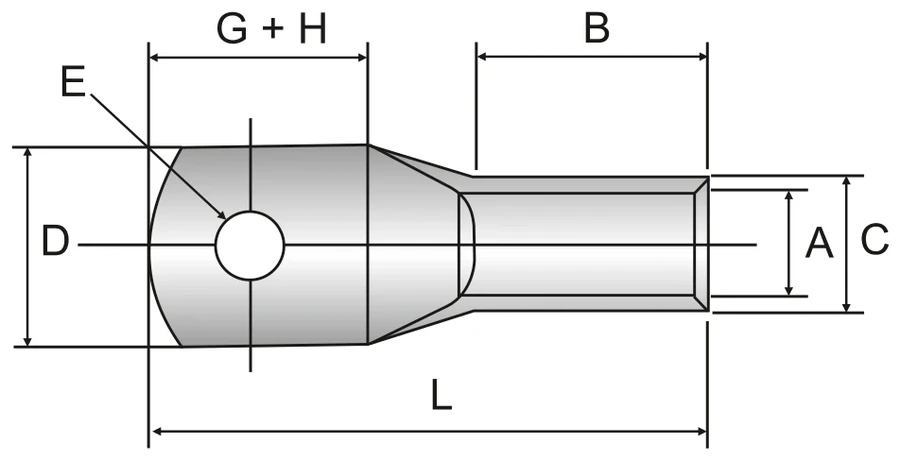
Every Exar cable lug page has a dimensioned drawing and a full dimension table, and all of them are in the cable lugs catalogue. Exar Industries manufactures cable lugs in Ahmedabad, India, and exports them to the Gulf countries, Southeast Asia, Africa, Latin America and other export markets.
Made in Ahmedabad, India
Tell us the lugs you need.
Send the lug type, cable size, stud hole and quantity. We reply with price and delivery.